
25th September 2023
Artificial intelligence for marketers. Friend or foe?
Spend any amount of time in marketing and you’ll surely discover these truths:
- Marketing loves hype
- Marketers struggle to tell the difference between hype and reality
- Marketers could sure do with some extra intelligence (artificial or otherwise)
Joking.
Probably.
But there’s no doubt that hype, especially in the worlds of digital and tech, is a major issue. So much so that Gartner developed its Hype Cycle to try and help people not get too caught up in the chaos that surrounds emerging technology and trends.
As Gartner point out when explaining the purpose and methodology of their Hype Cycle in the world of tech bold promises are the name of the game, but talk is cheap and not all (or maybe most?) tech lives up to that ‘blue sky’ visioning that founders and billionaires love to peddle.
Of course that doesn’t mean it’s all empty bombast. Some new, emerging tech can deliver on some version of what’s promised at some time in the future. The questions are which tech, which version of its promise, and when can people expect to see hype become something approaching a reality that is commercially viable and personally useful.
Artificial intelligence, especially generative AI like ChatGPT and Dall-E, is certainly le hype du jour in the general zeitgeist (I never did do well at foreign languages at school, maybe I should have used ChatGPT to assist on that last bit…) and marketers have been going crazy for it. Most fall into two camps:
- So I can get paid while getting a machine to do all my work for me? Amazeballs!
- So I’m going to get laid off because a machine can do all my work for me?!
Gartner’s Hype Cycle predicts that generative AI is approaching peak hype (that point where even your CEO Gran namedrops the tech). And if (as is probably likely) it follows the usual pattern we’ll soon see a ‘Trough of Disillusionment’ where we realise that the promises probably aren’t quite going to be lived up to (and we’re all shocked, like how the aforementioned Gran still can’t believe we’re not living on the moon and getting our meals in a pill). This disillusionment leads to the eventual ‘Slope of Enlightenment’ where the technology matures and we adapt to its limitations and find productive valuable uses for it. From there it’s on to the heady heights of the ‘Plateau of Productivity’ where the tech then becomes a part of our background lives in its more limited but still very useful (hopefully) form.
And frankly long before we get far along the ‘Slope’ we’ve almost certainly moved on to another hype that’s stressing marketers out (remember when cracking the Metaverse was your number one strategic objective, ooooh, about 12 months ago? Yeah…how’s that coming along?).
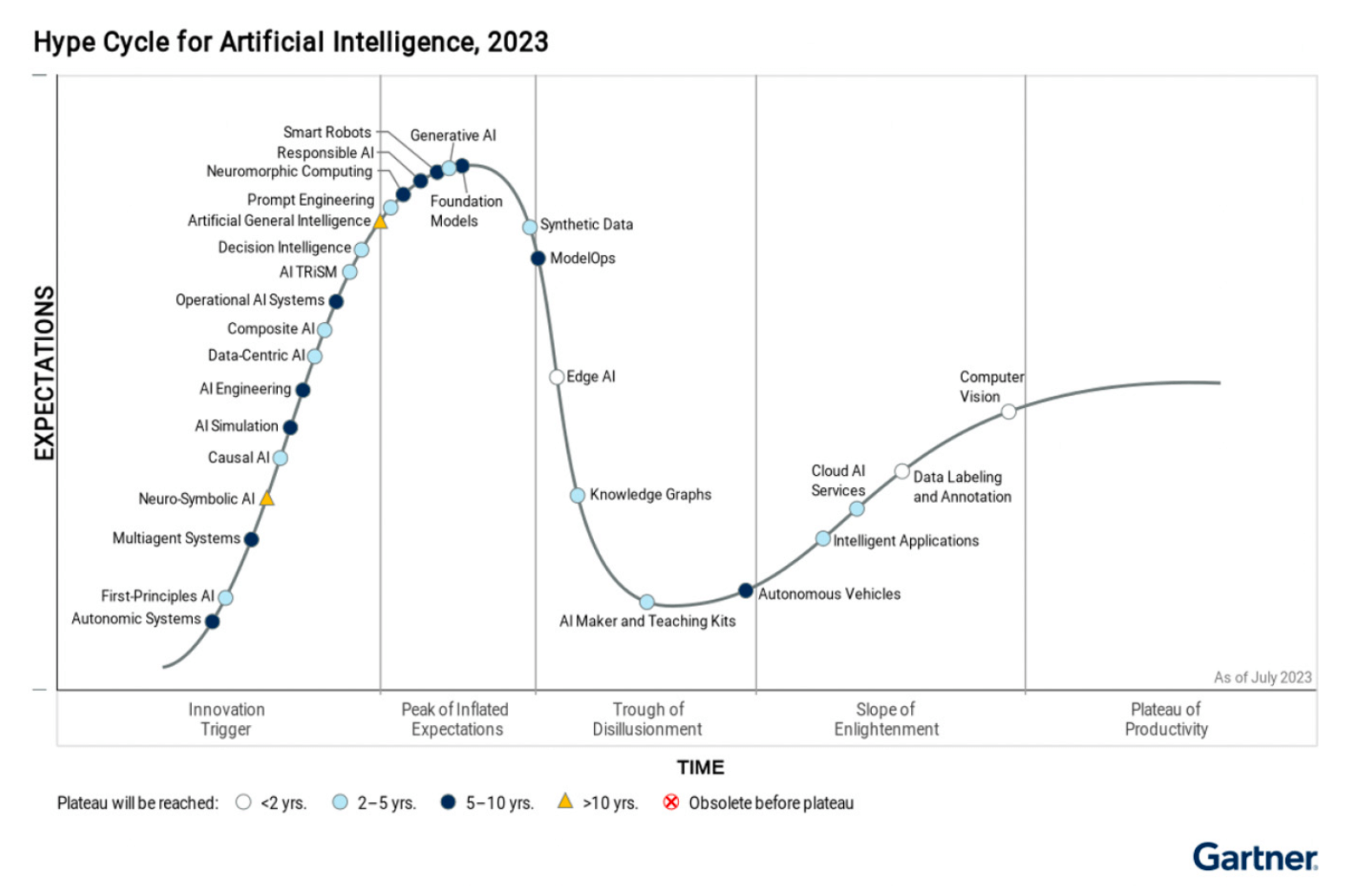
With this in mind (and we’re not saying Gartner are infallible, they certainly aren’t, which camp should marketers be in?
Is artificial intelligence for marketing going to lead to a promised land or a slough of despond?
The truth is probably somewhere in between, and might depend on how you approach the whole thing.
Some examples of artificial intelligence in marketing
Artificial intelligence examples abound, and unless you’ve been living under a rock you’ll have seen news reports of AI’s use in genuinely life changing situations like cancer detection. In the world of marketing some of the leading uses or potential uses include:
- Image generation – With tools like DALL-E it’s possible to generate photorealistic images to your unique specification. There’s been issues around this, with agencies like Getty suing one AI platform because it’s apparent that the platform has been trained on its copyrighted images. But artificial intelligence has also been put to use in marketing campaigns to create campaign images, as in this campaign for Heinz. It can also be used to create unique imagery for pitch and presentation decks when stock photography isn’t quite giving you what you need.
- Written content – Artificial intelligence for writing has been one of the biggest use cases by marketers. And students who can’t be bothered to learn their subject and write an essay. AI writing tools can certainly help speed up content creation, using prompts and information to create a first draft of an article or presentation for you. Want a whole bunch of potential headlines for an ad? ChatGPT can pump out dozens of options far faster than even the most productive copywriter. But the quality can be suspect. However it can kickstart your own creative process. One thing to be aware of if using it to write anything in depth is that ChatGPT is known to completely fabricate information, sources, and references, so thorough reviewing and editing is required.
- Insights and strategy – AI has been used for sometime in various tools to speed up collating and dissecting data, and it can also be used to aid your strategic thinking. Strategy whizz Julian Cole sees it as similar to a junior planner in that you can set it to gather large amounts of information and give you easy to understand synopses of issues, provide starting ‘insights’ and speed up brief writing. As with written content though, the outputs rely heavily on both comprehensive prompt writing from the marketer and close review, analysis, and editing of the output. Shit in shit out as the saying goes.
- Web development/coding – There have been several high profile instances of people using AI to generate the code for websites, basic videogames and more. And if you’re a non-programmer and want to quickly create a script to help you in Excel or whatever then AI can help. AI can definitely support and speed up developers on basic tasks, bug detection, and so on, but it’s clear that human developers and their creative thinking and problem solving isn’t matched by AI. Remember that AI coding is a nascent field and, as with written content, the machine is trained on inputs from all over the internet, much of which is less than stellar.
The potential benefits of artificial intelligence
The immediate benefits for artificial intelligence in marketing is the ability to harness its powers to handle large scale repetitive tasks that otherwise take up a lot of time and effort. And which are often, frankly, quite boring to do. Churning out reams of informational copy on a website, for example.
There’s scope for AI to help in many areas of marketing in this way, and indeed it’s already being used for it: A/B testing hundreds of different ad combinations, colour correcting images, creating and enhancing visuals, and so on.
What this should mean, in theory, is that people are freed up to do more of the creative and thinking work that adds real value to businesses. And as we’ve seen AI can even help there, acting as a first draft idea generator, researcher and so on. Yes the outputs can be variable in quality and the AI can’t do the whole job, but it can provide stimulus and surprising directions.
So AI has the potential to enhance what we do, not replace us.
The potential pitfalls of artificial intelligence
Putting aside the rise of the robots leading to mass unemployment and our eventual enslavement (one of which feels more real in its potential threat level than the other), AI comes with its pitfalls.
As mentioned previously, it’s known to fabricate sources and content, so there is an inherent issue around whether you can trust what it’s telling you.
It also seems that ChatGPT has begun to ‘cognitively decline’ in a number of areas, without any good explanation as to why. So if AI becomes tightly ingrained into our ways of working but gets steadily less effective, how much time will be taken up unpicking issues and errors? And will these errors leak out before they can be caught and corrected?
And there’s also the potential that this incredibly resource intensive technology (which requires copious amounts of power and water to train and then function) becomes even more impactful on our environment than anything else.
What does the future hold?
For marketers there is a real opportunity to use AI to help them get more done with more efficiency, and free them up to focus on creativity, strategic thinking, and other areas that will add more value to their business. And ultimately that’s what you want: AI enhancing marketers not replacing us.
So, will it be the Star Trek future most of us yearn for, where computers and machines carry out all the boring jobs and allow us to be our best selves, traversing the stars in a post-scarcity utopia?
Or will it be the bleak, authoritarian world of 1984 or Bladerunner where corporations and governments collude in an architecture of control, and saccharine songs recorded by fictitious artists are pumped out to sedate the proles, while the planet burns around us?
Probably somewhere in between those two extremes.
Time for a cup of tea. Which I’ll brew without any AI intervention. For now.