
6th July 2023
Top SEO tools for eCommerce websites
Are you an e-commerce retailer wanting to improve search visibility, site visits and ultimately sales? You’re reading the right article. Below, we discuss some of the best SEO tools that can help eCommerce sites achieve those business objectives – they’ve been chosen by our SEO team, who have experience working with the likes of Sainsbury’s Group and Decathlon.
What is visibility?
I mean, you’ve made it this far, so you must know what visibility means. But to keep things consistent here:
As the name suggests, visibility is a metric that indicates how visible a website is in search engines’ organic results. Your ‘score’ represents how well you rank for the entire keyword set related to your website. It’s more than raw traffic numbers; instead, think of visibility as your position in SERPs relative to your competition.
The relationship between SERP visibility and online sales is intrinsic, which is why it’s crucial for eCommerce websites to invest in SEO and be ‘seen’. The first tool we’ll look at is extremely useful for monitoring visibility.
Sistrix
Sistrix is a powerful SEO tool that helps e-commerce websites in couple ways, including:
1. Visibility analysis
Use Sistrix’s ‘overview’ and Visibility Index resources to monitor the visibility level of a website. Showing daily mobile data and weekly desktop data, you’re provided with an exact Visibility Index score for your sites. The calculation process:
- Collects the search results for a million search queries (keywords) to determine data points
- Weights the data points according to search volume and expected click probability
- Adds up the weighted values – the sum gives the Visibility Index
It’s also possible to monitor competitors’ visibility levels through the tool, and you can overlay data if you want to compare several websites. Major Google algorithm updates are also marked with pins on the visibility graphs.
Why is it important for eCommerce websites to regularly analyse visibility levels?
- Assimilate how organic search visibility impacts sales
- Note current areas of strength
- Outline concerns that may need addressing
2. Analysing the performance of specific website sections
Gain insights into how areas of your eCommerce website are performing via Sistrix’s ‘directories’. This breaks down visibility levels of different page types, and allows you to go a step further by assessing specific URLs within a page type. You can simply enter a product category URL, to see how visible it is, for example.
Again, it’s possible to overlay data to cross-compare categories and determine which parts of your site are more visible to search engines than others.
3. Basic SEO tips: keyword rankings
Sistrix’s useful keywords section provides insights into the performance of keyword groups and individual keywords. Here, you can see ranking changes over a defined period, plus suggested SEO keyword tips and opportunities.
Quick note: Sistrix has been gathering SERP data since 2008 and mobile data is updated daily. That makes it a go-to tool for e-commerce websites since data from these sites requires frequent analysis. They also offer a useful blog page filled with news, expert opinions and SEO tips for beginners.
On-page SEO tips and tricks: site crawling & auditing tools
Site crawling and auditing are key to ensuring any website remains healthy and free of potentially damaging issues. We recommend using a variety of tools, because issues that are missed or slightly hidden in one tool may be picked up or made more prominent by another.
Screaming Frog is an undisputed winner when it comes to site crawlers, and therefore one of our top picks. Additionally, some of our SEO team’s favourite auditing tools include Botify, Deepcrawl and Oncrawl. These platforms pull in data from different SEO elements that may need tracking and have the ability to produce custom reports.
Use these tools frequently to identify technical and on-page issues that impact search engines’ ability to:
- Crawl your site: Check for crawl errors, broken links, and accessibility issues that hinder search engine bots from navigating your website effectively.
- Index primary pages: Ensure that important pages are correctly indexed by resolving duplicate content, optimising meta tags, and utilising proper canonical tags.
- Rank pages: Analyse keyword rankings, optimise content for relevant keywords, improve page load speed, and enhance mobile responsiveness to boost search engine rankings.
Quick note: We advise that you crawl your e-commerce website about once a week.
Google Merchant Centre
Having a Google Merchant Center account is essential for any e-commerce website. In simple terms, without Google Merchant Center, your products cannot appear in Google Shopping results.
A Google Merchant Center account is necessary to provide and manage relevant product information for displaying product ads. Essentially, this tool serves as the gateway for e-commerce sites to advertise their products effectively on Google Shopping. Therefore, it’s highly valuable for any online store.
Google Search Console
When aiming to rank your e-commerce website and attract traffic through search engine results pages (SERPs), paying attention to Google’s recommendations is essential. Google Search Console serves as Google’s dedicated tool for identifying and reporting issues with your site.
From monitoring Core Web Vitals and assessing status codes to managing sitemaps and structured data, it offers a comprehensive overview of your website’s performance. It not only highlights potential issues but also suggests actionable steps to enhance your site’s ranking potential. Therefore, Google Search Console is indispensable, regardless of your website’s size.
Google structured data testing tool
Structured data is a crucial SEO component for e-commerce websites. The ability to include elements such as review ratings, stock level information, and prices should not be overlooked. If you want to test and validate structured data for your site, Google’s Structured Data Testing Tool is the ideal resource.
Google constantly integrates structured data and schema.org into its Knowledge Graph, making this tool exceptionally powerful. It also enables you to create new pages and manually optimise existing ones.
Google business profile
Continuing with Google tools, another valuable resource for e-commerce websites is Google Business Profile (formerly Google My Business), which allows you to create a ‘mini shop’ directly within your profile.
Firstly, there’s a dedicated products section where you can list items from your e-commerce site. Each product listing includes fields for product image, name, description, price range, and a button to link directly to the relevant URL where customers can make purchases. These listings appear in a mini slider format.
Secondly, you can organise your listed products into categories. These categories are displayed as tabs within your business profile listing on SERP pages, enabling customers to click on them and view products within their chosen category.
If you’re not already using this free tool, we highly recommend doing so. It enhances your visibility in search results and contributes significantly to building your brand identity.
Corigan
This suite of AI-driven tools, developed by Organic developers, empowers e-commerce brands to take charge of their search performance and scale their SEO efficiently. How? Corigan consolidates business, management, technical, and content workflows into a unified platform.
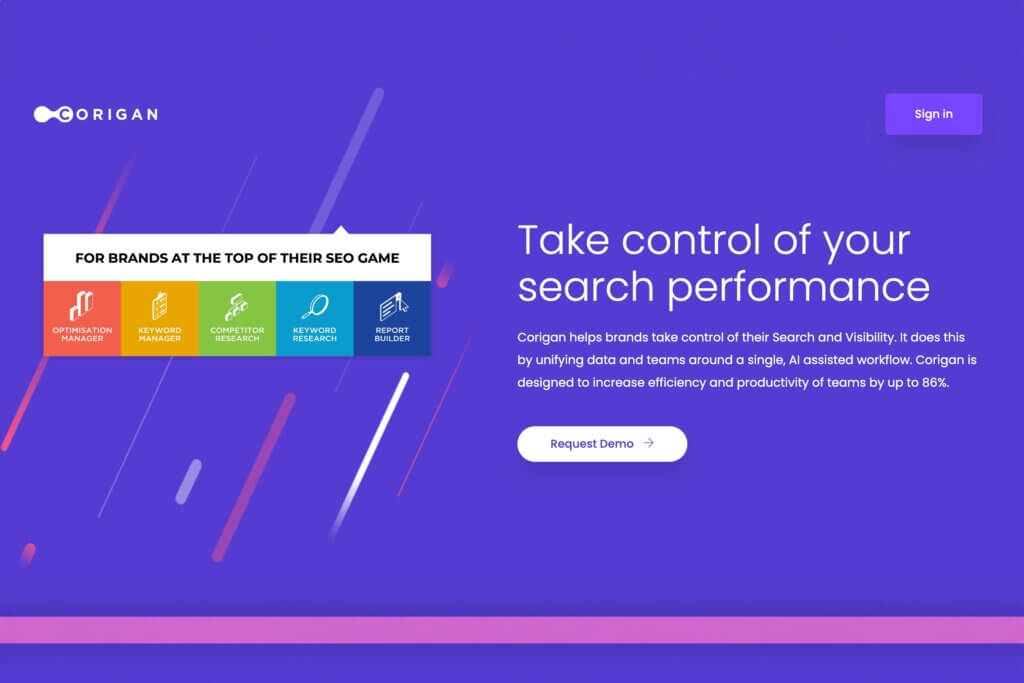
Corigan automates internal linking, link management, and content briefing workflows. This transformation allows tactical optimisations on key pages to evolve into strategic initiatives across all pages. Additionally, Corigan provides:
- Reporting and monitoring capabilities
- Competitor analysis using matched pages
Its automation of keyword management eliminates the need for shared spreadsheets, providing a holistic view of target pages organised by keyword. The platform also includes search and tagging functionalities to streamline workflows.
Keyword tools
As mentioned earlier, Sistrix offers keyword tracking and analysis, but there are other tools with similar capabilities. For keyword research, consider Keyword Keg.
If you need to gather current or historical ranking data, find suggested keywords relevant to your business, and conduct in-depth keyword research, we recommend Ahrefs. This trusted tool features an impressive filter system that helps you refine data until you have a detailed result ready for export.
Email marketing tools: Mailchimp, Klaviyo…
Ok, so this isn’t directly related to SEO and improving search performance, but any e-commerce website should consider email marketing as part of their wider strategy. Contacting existing or prospective customers about discounts, promotions, new products and updates that could positively impact sales is often a cost-effective part of an overall marketing strategy. Various options can help, but the two we suggest are Mailchimp and Klaviyo.
While not directly related to SEO and improving search performance, email marketing is crucial for any e-commerce website as part of a broader strategy. Contacting existing or potential customers with discounts, promotions, new products, and updates can significantly boost sales. Two highly recommended options for email marketing are Mailchimp and Klaviyo.
Best SEO tools
For those prioritising SEO in e-commerce, leveraging the mentioned tools is essential for achieving your goals. For ongoing SEO insights and actionable tips, visit our case study page showcasing our ongoing work.
And remember, SEO isn’t the only crucial marketing aspect for e-commerce success; paid search also plays a significant role in your overall marketing mix.